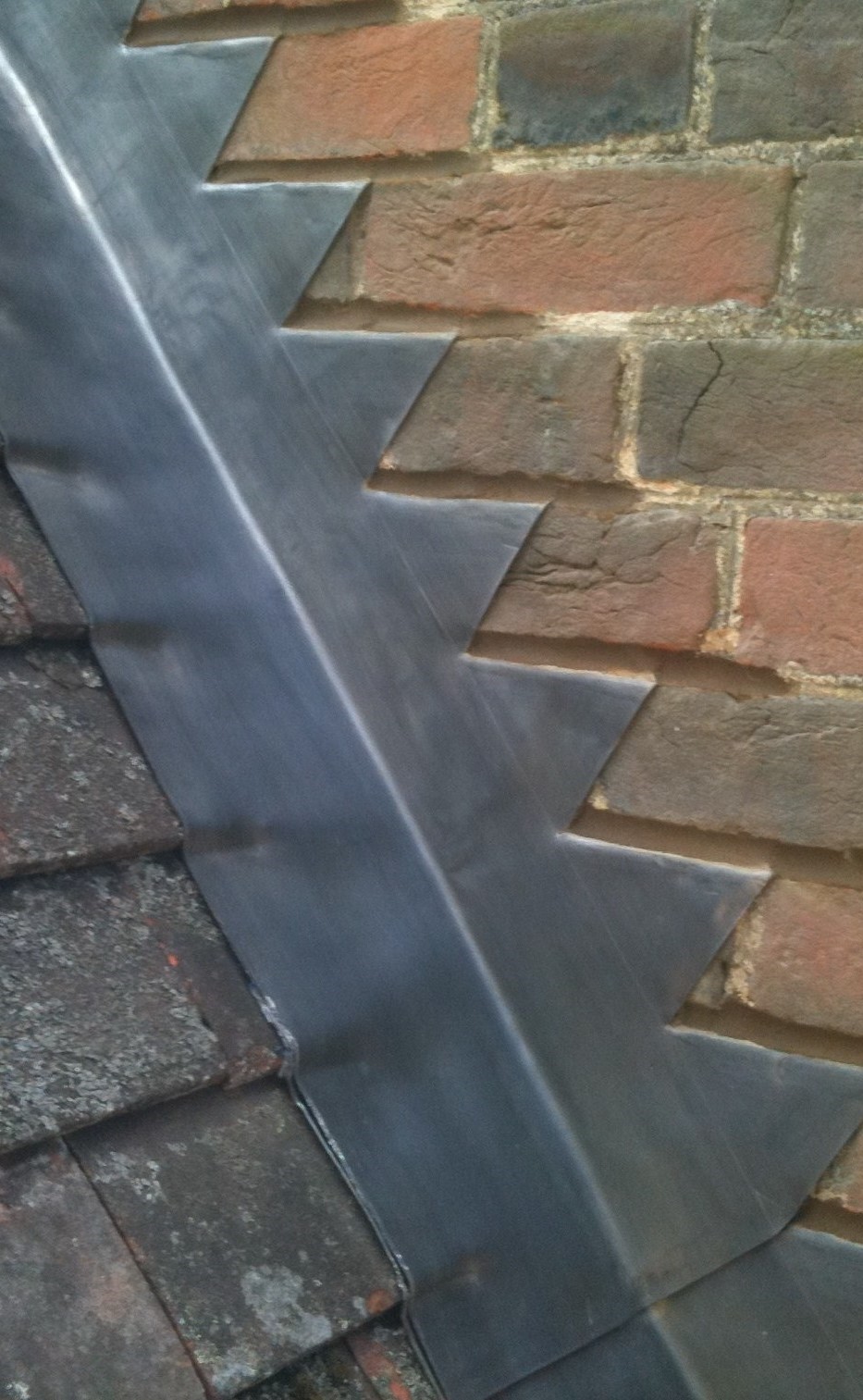
A roof leak is rarely obvious at first. Water enters through a small gap, travels along rafters or underlays, and appears as a damp patch in a completely different place — often weeks or months after the original breach. This makes tracing leaks one of the more skilled parts of roofing work.
Here are the most common causes we see across Birmingham and the surrounding area — and what the correct fix looks like for each one.
Failed or lifted lead flashing
Lead flashing creates a waterproof seal between the roof and any vertical surface — a chimney, a dormer wall, a parapet, or an abutment. When lead flashing fails, typically through thermal movement cracking the mortar pointing or through the lead itself lifting or splitting, water runs directly behind the tiles in heavy rain.
This is the single most common cause of the classic "leak around the chimney" complaint. It's also frequently misdiagnosed — homeowners see damp inside near the chimney and assume it's the chimney stack or pot, when the actual failure point is the lead at the base of the chimney where it meets the roof.
Slipped, missing or broken tiles
A tile or slate that has slipped out of position exposes the underlaying felt to direct water exposure. A single slipped tile isn't usually catastrophic on its own — most roof felts will handle light rain — but sustained exposure leads to felt deterioration, and in cold weather water trapped behind slipped tiles can freeze and push adjacent tiles out too.
On older roofs (40+ years), nail failure is the typical culprit — the original iron nails corrode through, and tiles begin sliding down the roof. In very cold winters this process accelerates significantly.
Failed ridge or hip tile mortar
The ridge tiles along the top of a pitched roof and hip tiles along the sloping corners are bedded in sand-and-cement mortar. This mortar has a finite life — typically 20–30 years — after which it cracks, erodes and eventually falls away, leaving gaps that leak badly and loose tiles that are a falling hazard.
De-bonded ridge tiles are one of the most common post-storm roofing problems. High winds get under ridge tiles whose mortar has already failed invisibly, and lift them completely.
Cracked or eroded chimney stack pointing
The mortar joints between the bricks of a chimney stack (the "pointing") are constantly exposed to freeze-thaw cycles, and erode faster than the brickwork itself. When pointing fails, rainwater penetrates the brick joints and can saturate a chimney breast inside the property — often appearing as a damp patch on an upstairs wall, or as efflorescence (white salt deposits) on the chimney breast plaster.
Valley gutter failure
The valley is the internal angle where two roof slopes meet. It carries a large volume of water — effectively the combined drainage of two full roof slopes — through a lead or mortar-bedded tile valley. When the lead corrodes through, or valley tiles crack and shift, the concentrated water flow finds any gap quickly.
Valley leaks often appear inside as water stains running diagonally across a bedroom ceiling — following the line of the valley above.
Flat roof blistering, splitting or delamination
Flat roof felt blisters when moisture trapped between layers is heated by the sun and expands. The blister eventually splits, creating a direct water entry point. EPDM and GRP flat roofs can develop lap failures where sheets or panels join — particularly if the installation used inadequate adhesive or bonding.
Blocked or overflowing gutters
Gutters that are blocked with leaves, moss or debris cause water to back up and overflow — running down the fascia, into the soffit, and sometimes into the roof space at the eaves. This is frequently mistaken for a roof leak because the water appears to be coming from around the roofline. Regular gutter clearing (typically twice a year — spring and autumn) prevents this entirely.
Finding the Actual Source of a Roof Leak
Because water travels along structural members before appearing inside, the visible damp patch is rarely directly below the entry point. A systematic approach works best:
- Note the position of the damp patch relative to the roof layout — is there a chimney, valley, or flat roof section above it?
- Go into the loft space during heavy rain if possible — you can often see or hear where water is entering.
- Have a roofer inspect from roof level — most entry points are immediately visible to an experienced eye.
Leaks that appear only in very heavy or wind-driven rain are often flashing or pointing failures — these typically require a storm level of rain to overwhelm the seal. Leaks that appear after any rainfall are more likely to be tile failures or blocked gutters.
Got a roof leak in Birmingham?
We'll find the source and give you a fixed-price quote to fix it properly. Available 7 days a week — same-day response for active leaks.
Get it fixed today →